Dr. Antonio Lopez Is Still Writing East Palo Alto's Story, One Poem at a Time
Dr. Antonio Lopez, San Mateo County Poet Laureate, on poetry, power, and giving back. The first Cafecito with Emmy-nominated Silicon Valley Latino.
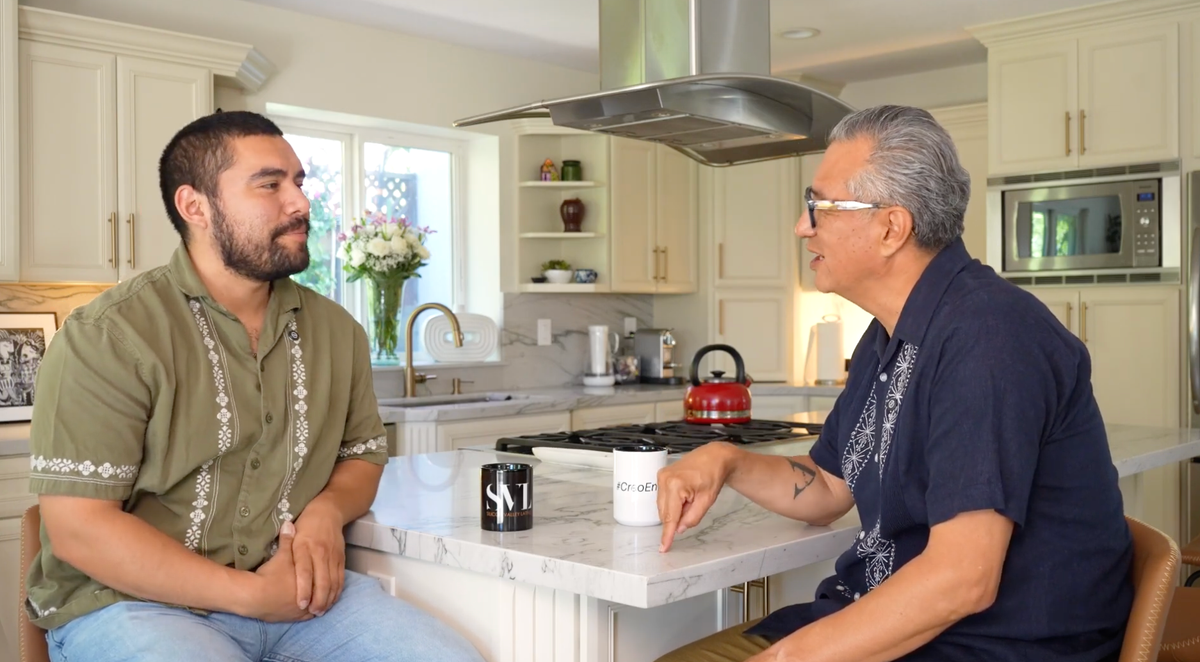
Cafecito with SVL, Episode 1
Cafecito with SVL is Silicon Valley Latino's new conversation series, coffee-style conversations with the Latino voices shaping our community. In Episode 1, SVL CEO Alex Ontiveros sits down with Dr. Antonio Lopez, poet, former East Palo Alto city council member, and San Mateo County Poet Laureate, to talk poetry, power, and the place that made him.
"The decisions you guys make now are gonna affect the rest of your life."
An eighth grade teacher named Miss Fitch said that to a room of 32 kids crammed into a Title I classroom in East Palo Alto. She slammed a textbook down to make her point land. Dr. Antonio Lopez was 13 years old. He didn't have a bigote yet. He didn't understand what she meant.
He understands it now. He has spent the years since turning that understanding into poetry, into public office, into a PhD, and into a body of work that keeps circling back to the same question: what do we do with the experiences that shape us, and who do we become responsible for once we've survived them?
A Zip Code Away from Stanford
Lopez is East Palo Alto, through and through. His father, mi papá, left Michoacán on his 18th birthday in 1983 and got amnesty under Reagan. Lopez grew up a zip code away from Stanford and Google, in a Silicon Valley that, in his words, wasn't always silicon for everybody.
He remembers the corners. The handwritten signs. The balloons. The epitaphs for people lost to violence or tragedy before they had the chance to grow up. Those memories don't disappear when you become successful. They wait.
From Scholarship Boy to City Council
Lopez went from EPA to McNair to Menlo School, then Oxford, then a Stanford PhD he finished just two weeks before sitting down for this conversation. For a while, he admits, he chased the prestige. "You start to drink the Kool-Aid," he said. He became what Richard Rodriguez calls a scholarship boy, a poster child for what a kid from EPA could accomplish.
Then the pandemic hit. His father got furloughed. People he knew got sick. People died. And Lopez hit what he calls an existential crisis: all these degrees, all these fancy names, so what? The people he cared about most weren't going to read his dissertation. They didn't know where Oxford was. "They think Oxford, 'Oh, you mean Oxnard, like California?'"
That crisis is what sent him into public office. He ran for East Palo Alto City Council on a whim and served four years, walking the walk instead of just talking about representation. He had about $6,000 in the bank while he was in office. Public service, he says plainly, is public sacrifice. He lost his evenings. He spent hours away from his family.
Along the way, he became the Poet Laureate of San Mateo County and published Gentefication, a poetry collection that plays on the word gentrification while claiming gente, our people, as its own universe. His new book, The Right to Remain Violets, comes out through University of Arizona Press in early spring 2027. The title remixes the Miranda warning. Where the state tells you that you have the right to remain silent, Lopez writes about what you do with the memories and experiences that shaped you: classmates who ended up in gangs or in trouble, and the systemic issues of the district, told through real newspaper articles and real research data.
When Tragedy Hits, People Ask the Poetas to Speak
In 2023, a shooting in Half Moon Bay shook the region, and it is one of the reasons Lopez got involved with ALAS. At an ALAS event, Dr. Belinda Arreaga asked him, still a sitting council member, to come up and say a few words. He read a poem about going to Oaxaca, meeting the families, and FaceTiming with a victim's sister, a trip where, he says, a piece of his heart was buried.
Alex Ontiveros remembers the room. "There's no elected official I've ever met that has the dynamic elements that you do," he told Lopez on the recording. Lopez's answer gets at why poetry, not policy language, is what a grieving community reaches for: "It's not an accident that after shootings or tragedies people ask the poetas to speak." Politicians can throw money and words at a moment like that. Only the poets, he says, can capture what people are actually feeling.
That belief runs through everything he makes. His poetry is meant to work like a mirror: who is my gente, and who am I leaving out of the room? He wants readers challenged, a little uncomfortable, but never without hope. Even the heaviest of his work carries ánimo, the refusal to be discouraged, because that, he says, is what we're made of.
Chest in Front, Elbows Out
Lopez left city council to finish his doctorate and now works with ALAS, helping build out the organization's research while keeping his creative life going. Days before our conversation, that meant Washington, DC, meeting with congressional offices as part of a Robert Wood Johnson Foundation grant focused on early childhood intervention. The same week it meant Sacramento, advocating for a state bill. In between, he's still writing.
He's direct about why the work matters right now. DEI is a band-aid, he says, because at the root are people systemically left off the guest list at their own table. He points to Dr. King's answer when asked why the riots of his era were happening: a riot is the language of the unheard. People rebel, Lopez says, when they're tired of being given the short end of the stick.
His answer to that exclusion isn't retreat. It's ownership. He wants our community to stop waiting for the day we go back to Durango, because for our kids, that day isn't coming. This is home. And the unlearning, he says, is to stop feeling like we don't belong here. "We do. And we ought to go in with our chest in front, elbows out." Imagine how boring and bland this region would be without the cultura, the sazón, the flavor. Little Saigon in San Jose. Little Manila in Daly City. The Bay's Black and brown melting pots are a slice of America that has always existed. "We're just as Silicon Valley as anyone else."
Still Writing
Dr. Antonio Lopez is now an official SVL Cultura Ambassador and contributing writer, with an open invitation to publish his reflections, his poetry, and his advocacy work with our community. When we sat down on July 3rd, he had just finished his PhD, a wedding was on the calendar, and he hadn't ruled out running for office again. For now, family and financial footing come first. A film project is already in motion for the inaugural Silicon Valley Latino Film Festival, and we'll go deeper on it in a future episode of Cafecito.
His message, the one he carries onto every stage and into every meeting, is this: fear is what keeps our community quiet. The antidote, he says, is what Dr. Belinda Arreaga calls la cultura que cura, our culture that empowers. Feet on the ground. Chest up. Still writing.
This conversation is the first in Cafecito with SVL. Watch the full episode above, and subscribe to Silicon Valley Latino on YouTube so you never miss the next one.
Stories like this don't tell themselves.
SVL has spent over a decade making the invisible visible, celebrating Latino excellence, naming hard truths, and calling our community to action. Independent Latino journalism only survives when the community it serves decides it's worth protecting.
There are two ways to stand with us:
Are you a Latino professional, entrepreneur, or leader ready to be celebrated? Become a Cultura Ambassador, SVL's official community membership for Latino leaders who are ready to have their story told, their work amplified, and their excellence made visible.
Want to support our mission? Become an Amigo de SVL. Your support keeps our journalism independent, our stories free, and our #CreoEnTi programs and community events alive.
Juntos Adelante. Because silence is complicity. And so is inaction.
#WeAreSVL | #JuntosAdelante | #CreoEnNosotros | #SVLVoices | #Cafecito | #CulturaAmbassador